When to Prune and How to Do It Right
When to Prune and How to Do It Right

Pruning in the correct manner and at the proper time can help to maintain the size and shape of your woody shrubs, improving their appearance and appealing to the artist in every gardener. Pruning also plays an important role in the health, productivity and well-being of woody plants. Three techniques that are important to understand if you are pruning your woody plants relate to tool sanitation, proper cutting technique, and pruning timing.
FIRST, SANITIZE YOUR TOOLS:
Always use clean pruning shears and be sure to sanitize the shears after each use. This is easily accomplished by either dipping them or wiping them down with 70% Isopropyl Alcohol. Some folks use a 10% bleach solution for this purpose, but it tends to have a corrosive effect on your tools over time.
SECOND KNOW THE CORRECT TECHNIQUE:
There are two main types of cuts that you can make while pruning, one is called a “heading cut”, in which the tips of branches are removed. This type of pruning is used to create dense regrowth near the cut, as would be expected in a hedge. The other type of cut that is often used is a “thinning cut”, in which an entire branch is removed at its base on the main stem or along a larger branch. Thinning helps to allow more light to enter the shrub and is the preferred method if the pruning goal is to maintain a natural form.
Take care when making cuts to look for the raised ridge of bark around the shoot that you are pruning and make your cut so that that ridge is left intact. Tissue in this ridge of bark will help promote sealing of the cut, so if you damage it, you may be inviting problems. It is also important to cut close enough to this ridge without leaving a stub, which can also slow the sealing process. Use the three-cut method, explained on the right, to avoid damaging the bark around the cut.
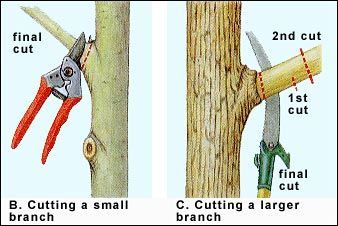
THE THREE-CUT METHOD:
- Cut a notch above where you plan to make your final pruning cut.
- Cut the branch off above the notch to remove the weight of the branch-this will leave a stub.
- Make your final cut just above the branch bark ridge, leaving a clean opening that can begin to heal.
THIRD, KNOW WHEN TO PRUNE:
I’m often asked when is the best time to prune hollies, crape myrtles, gardenias, azaleas, boxwoods, or any other woody plant you can think of. It can be very confusing to know when to prune flowering plants or evergreen plants. The following are some basic rules that will help you determine when to prune your landscape plants.
Rule No. 1
If the plant blooms in the spring such as azaleas, dogwoods, forsythia, or mophead hydrangea, then it should be pruned right after blooming. Spring flowering plants form their flower buds in the fall. If these plants are pruned in late winter then the flower buds will be removed and as a result there will be no spring flowers to enjoy.
Rule No. 2
If the plant blooms in the summer, then prune in late winter (late February to early March) while the plant is still dormant.
Rule No. 3
If plants are not grown for their flowers, the best time for pruning is during the dormant winter season (late February to early March) before new growth begins in the spring.
Rule No. 4
Do not prune during the late summer and fall because new growth may occur and make the plants more susceptible to cold injury.
There are some exceptions to these rules. Remove anything that is dead or diseased any time of the year. Another exception would be to clean up the overall appearance of a spring bloomer that has not been pruned in a very long time. For example, if an azalea is ten feet tall and scraggly and doesn’t flower well, then by all means prune it in the late winter to clean it up. The plant won’t flower in the spring but it will at least have a healthy start in the spring and will bloom the following year.
Some trees may bleed (it’s really sap) after pruning. Examples include willows, birches, maples, beeches and dogwoods. Bleeding may be unsightly but typically is not harmful. However, if you don’t want the tree to bleed, then prune in late spring or early summer when there are leaves on the trees. Actively growing leaves tend to reduce the amount of bleeding from pruning cuts and allow the cuts to heal more quickly.
To obtain more information on the correct way to prune, you can download the following University of Georgia Extension publications Basic Principles of Pruning Woody Plants and Pruning Ornamental Plants in the Landscape, below.
Article by Mary Carol Sheffield, University of Georgia Cooperative Extension Agricultural and Natural Resources Agent, Paulding County